How Google Books is Changing Academic History
Six months turns out to be a long time in book land. In that period of time, Book Search has accomplished enough to transform the academic profession.
I was idly trying a search on "roads" to see what sort of a literature would turn up for the period of my dissertation research, 1740-1850. I didn't expect much. I've spent the last two years wandering through the Yale, Harvard, and California libraries, the British Library, Britain's National Archives, and the immense reserves of North American Inter Library Loan reading every book on London, pavement, or travel I could get my hands on.
Surprise. In a single idle search I just added twenty extra full-text books to my list.
Which are, by the way, full-text searchable --
-- and subject to word-count analysis --
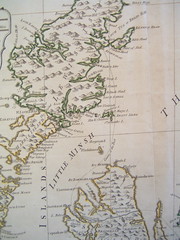
-- and replete with full illustrations --
-- and instantly digestable into visuals for powerpoint presentations.
Hallelujah, GoogleBooks. And holy mackerel! Good work.
By now, the first half of the nineteenth century exists in a very complete form on Google Books. In the last six months, while academic history has meandered in its habituated paths of grinding research, the possibilities of scholarship have been utterly transformed.
To give just one example, this little puppy -- Henry Parnell's A Treatise on Roads (1833) -- one of the key texts for my dissertation exists on our campus in Berkeley's transport library, a quaint but understaffed, spare room
hidden on the third floor of the engineering building, far, far away from where historians ever go. It wasn't actually on the shelf when I got there, so it took some patient emailing with the transport library librarians before the book was found, returned to the correct place, held at the desk for me, to be picked up during the library hours specific to that particular institution (10am-4pm, M-Fr). Wild with enthusiasm at having at last obtained it, I held the volume prisoner at my desk in San Francisco for six straight months, unruffled by overdue notices, until at last the plaintive emails from the circulation desk were too much for me to bear. Research in my world is very often a personal matter of haggling for more time with the particular librarian in question. They're used to us, and I figure they need a good struggle to keep them alert. But thanks to Google Book Search, these days of scavenger-hunt and tug-of-war are drawing to an end.
Time for a professional dialogue about the new kinds of research these texts have opened up. For a very vast vista has erupted before us, and with it, a more serious set of comparative questions as a standard for social history, and new levels of rigor to be expected from the individual researcher. No longer can historians afford to stay in the empty, lonely world of the weary scholar, pouring of close readings of dialogue. Time for all those structural analysis skills to come back in full force. Quantitative and open databases of word-count and thematic analyses. Open databases of pictures, tagged by keywords and available for classroom use.
What this signals, by the way, is the opportunity for a new age of scholarship. Cultural and image analysis used to be painfully time-consuming, heavy lifting, involving rare kinds of access, full fellowships, immense travel, and long waits for delicate books. Comparison between different cultural sources was even harder, placing absurd demands on the cultural historian's personal memory and note-taking skills. Cultural historians, despite their many skills, stood second in depth of research on any particular topic to political historians, for whom one visit to a Parliamentary archive and one visit to a personal residence outfitted them with every last detail of historical change. Now all that is changing. Comparing a hundred images is no longer a problem for a year's labor in an out-of-the-way museum reading room. Comparing a hundred personal accounts from working men is no longer a task to eat up a social historian's entire year.
I'm looking forward to seeing what the future holds. Any reports of historians currently putting together databases? Please post them here. In the meantime, check out this afternoon's dissertation links...
Practical Remarks, and Precedents of... - Google Book Search
legal commentary on new pavement and turnpike legislation in parliament, 1802.
-
A Treatise on the Law of Ways - Humphry Woolrych, 1829
-
Steam Carriages on London Roads - Walter Hancock, London, 1838
-
A Treatise on Roads, Their History - Simeon De Witt Bloodgood - 1838
from Albany New York - lectures on the history of recent paving, with comments on tolls and despotism
-
General Rules for Repairing Roads for surveyors on the Holyhead Roads - 1827
-
Letter to Sir Alexander Muir M'Kenzie on Scottish Roads - McAdam - 1833
-
A Practical Treatise on Making and Repairing Roads - Edmund Leahy - 1844
-
Observations on the Formation, State and Condition of Turnpike Roads - A H Chambers - 1820
The Practice of Making & Repairing Roads: - Thomas Hughes - 1838
-
Rudiments of the Art of Constructing Roads - S Hughes - 1850
-
A Treatise on Roads - Henry Parnell - 1833
-
An Act [57 Geo. III. Cap. Xxix] for Better... - Google Book Search
Metropolis Paving Act, 1817 - Michelangelo Taylor Act (?)
-
Lights and Shadows of London Life - James Grant - 1842
descriptionof ethnic ghettos; Jews and Quakers, their neighborhoods andappearances. begging imposters and the typical figures of cantdictionaries
Hydraulia, an Historical and Descriptive... 1835, William Matthews
a historical description of London's water supply
-
Sinks of London Laid Open: A Pocket Companion...
George Cruickshank, 1848.A flash dictionary with excursions through lodging houses, kitchens, hells, etc.
Labels: academia, britain, britishstudies, dissertation, history, london, networking, research, roads, social, uk
posted by Jo Guldi at 5:54 PM
14 comments