Landscape organizes everything within sight.

Tuesday, August 19, 2008

Maps and Nationalism

We like to think that modernity means the spread of information. Newspapers, maps, travel: all these things supposedly bind peoples into a single national whole. We like to think these things are true; but sometimes such stories are too easy.

In 1775, Boswell had just heard that parts of the East Indies were better mapped than the Scottish Highlands of Britain itself, and he found the fact outrageous. Johnson merely observed, “That a country must be mapped, it must be traveled over.”

Boswell, a Scot, thought he better knew what his English friend was thinking. Don’t you meant to say, he jibed, that "it is not worth mapping?”

In 1784, the modern view of the nation, with its boundaries firmly delineated, the shape of the country itself an icon, was transmuted from the heavy volumes of private libraries consulted by the gentry, into a medium more common, widespread, and accessible. These maps, one assumes, should have brought to an end anxieties like Boswell’s (in 1775) over the position of any particular people, assimilating them all into a single icon of national unity. Sixty years before the arrival of a national press, the visible shape of the nation, in tangible and portable form, offered Britons a ticket for exploration and a tool for identity.

Yet the cheap printed map was also the child of twisted corridors of state dissemination. Republishing the results of military conquest and survey, the cheap printed map indirectly translated the state’s activities for a consuming public. That translation was idiomatic at best.

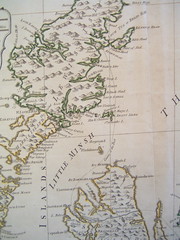
For reasons that hinged upon the history of military mapping and the government’s lead role in distributing geographic data upon which commercial maps depended, the nation depicted in these maps was informed by peculiar distortions. The survey of Scotland performed in the 1750s that became the basis for early nineteenth-century maps was trigonometrically out-of-date; as new surveys of Scotland were delayed by a military more concerned with troubles in Ireland, the outdated data was rejected by cartographers.

Publishers instead routinely depicted Scotland as a white corner on the map, lopped off by the edge of parchment that fell just above Edinburgh. The standard nineteenth-century map of Britain that hung in classrooms excluded most of Scotland from the nation pragmatically defined. Such facts raise the question of what nation, exactly, modern Britons thought they belonged to.


C. Smith, Smith’s Map of England & Wales (London: Printed for C. Smith, 1830). (view full image at the National Library of Australia)


The traditional story of how modern Britons came to understand themselves as members of a nation tells a far more straightforward account of what national implied. Since T. B. Macaulay’s History of England of 1848, official accounts of British identity have tended to emphasize the eighteenth and nineteenth centuries as periods of successful assimilation, in which the fissures of earlier religious and political divides were healed by the salve of commerce, communications, and military exercise. While some scholars interrogate the limits of assimilation, even then, the received narrative tends to take for granted the inclusive work of enlightenment processes like communications and mapping. In fact, mapping itself was a creature of government, like the government-directed military and postal communications that spawned the early surveys upon which commercial cartographers depended. As a result, public maps took on contingencies of intension and empire that worked to structurally exclude Scotland from full integration in the consciousness of ordinary Britons. London publishers complained and Edinburgh cartographers tried to remedy the situation, but neither succeeded. It was the confusion of government practice, rather than English prejudice or Scottish self-assertion, that erased Scotland from the national map.

The map could only direct the traveler as well as allowed by the militarized history of cartographic practice. The common travelers’ aim, unlike the state, was not to police, but rather to plan a route through known and unknown regions, determining the likelihood of trade and the relationship between territories for secure travel and territories of adventure. As students, geologists, and railroads adapted standard maps to their own purposes, the fissures of the nation enshrined in maps were carried over to other practice. The tangible shape of the nation had become a tool of national distortion.

Labels: , , , , , , , ,

Wednesday, March 14, 2007

How Google Books is Changing Academic History

Google Book Search is a relatively recent phenomenon... six months ago, right? About six months ago I was pottering around there, finding a few illustrated nineteenth-century texts, a lot of contemporary books for sale, and not much of too much interest.

Six months turns out to be a long time in book land. In that period of time, Book Search has accomplished enough to transform the academic profession.

I was idly trying a search on "roads" to see what sort of a literature would turn up for the period of my dissertation research, 1740-1850. I didn't expect much. I've spent the last two years wandering through the Yale, Harvard, and California libraries, the British Library, Britain's National Archives, and the immense reserves of North American Inter Library Loan reading every book on London, pavement, or travel I could get my hands on.

Surprise. In a single idle search I just added twenty extra full-text books to my list.

Which are, by the way, full-text searchable --

-- and subject to word-count analysis --

-- and replete with full illustrations --

-- and instantly digestable into visuals for powerpoint presentations.

Hallelujah, GoogleBooks. And holy mackerel! Good work.

By now, the first half of the nineteenth century exists in a very complete form on Google Books. In the last six months, while academic history has meandered in its habituated paths of grinding research, the possibilities of scholarship have been utterly transformed.

To give just one example, this little puppy -- Henry Parnell's A Treatise on Roads (1833) -- one of the key texts for my dissertation exists on our campus in Berkeley's transport library, a quaint but understaffed, spare room
hidden on the third floor of the engineering building, far, far away from where historians ever go. It wasn't actually on the shelf when I got there, so it took some patient emailing with the transport library librarians before the book was found, returned to the correct place, held at the desk for me, to be picked up during the library hours specific to that particular institution (10am-4pm, M-Fr). Wild with enthusiasm at having at last obtained it, I held the volume prisoner at my desk in San Francisco for six straight months, unruffled by overdue notices, until at last the plaintive emails from the circulation desk were too much for me to bear. Research in my world is very often a personal matter of haggling for more time with the particular librarian in question. They're used to us, and I figure they need a good struggle to keep them alert. But thanks to Google Book Search, these days of scavenger-hunt and tug-of-war are drawing to an end.

Time for a professional dialogue about the new kinds of research these texts have opened up. For a very vast vista has erupted before us, and with it, a more serious set of comparative questions as a standard for social history, and new levels of rigor to be expected from the individual researcher. No longer can historians afford to stay in the empty, lonely world of the weary scholar, pouring of close readings of dialogue. Time for all those structural analysis skills to come back in full force. Quantitative and open databases of word-count and thematic analyses. Open databases of pictures, tagged by keywords and available for classroom use.

What this signals, by the way, is the opportunity for a new age of scholarship. Cultural and image analysis used to be painfully time-consuming, heavy lifting, involving rare kinds of access, full fellowships, immense travel, and long waits for delicate books. Comparison between different cultural sources was even harder, placing absurd demands on the cultural historian's personal memory and note-taking skills. Cultural historians, despite their many skills, stood second in depth of research on any particular topic to political historians, for whom one visit to a Parliamentary archive and one visit to a personal residence outfitted them with every last detail of historical change. Now all that is changing. Comparing a hundred images is no longer a problem for a year's labor in an out-of-the-way museum reading room. Comparing a hundred personal accounts from working men is no longer a task to eat up a social historian's entire year.

I'm looking forward to seeing what the future holds. Any reports of historians currently putting together databases? Please post them here. In the meantime, check out this afternoon's dissertation links...

  1. Practical Remarks, and Precedents of... - Google Book Search

    legal commentary on new pavement and turnpike legislation in parliament, 1802.


  2. A Treatise on the Law of Ways - Humphry Woolrych, 1829


  3. Steam Carriages on London Roads - Walter Hancock, London, 1838


  4. A Treatise on Roads, Their History - Simeon De Witt Bloodgood - 1838

    from Albany New York - lectures on the history of recent paving, with comments on tolls and despotism


  5. General Rules for Repairing Roads for surveyors on the Holyhead Roads - 1827


  6. Letter to Sir Alexander Muir M'Kenzie on Scottish Roads - McAdam - 1833


  7. A Practical Treatise on Making and Repairing Roads - Edmund Leahy - 1844


  8. Observations on the Formation, State and Condition of Turnpike Roads - A H Chambers - 1820


  9. The Practice of Making & Repairing Roads: - Thomas Hughes - 1838


  10. Rudiments of the Art of Constructing Roads - S Hughes - 1850


  11. A Treatise on Roads - Henry Parnell - 1833


  12. An Act [57 Geo. III. Cap. Xxix] for Better... - Google Book Search

    Metropolis Paving Act, 1817 - Michelangelo Taylor Act (?)


  13. Lights and Shadows of London Life - James Grant - 1842

    descriptionof ethnic ghettos; Jews and Quakers, their neighborhoods andappearances. begging imposters and the typical figures of cantdictionaries


  14. Hydraulia, an Historical and Descriptive... 1835, William Matthews

    a historical description of London's water supply


  15. Sinks of London Laid Open: A Pocket Companion...

    George Cruickshank, 1848.A flash dictionary with excursions through lodging houses, kitchens, hells, etc.


Labels: , , , , , , , , , ,