Landscape organizes everything within sight.

Tuesday, October 11, 2011

Deracination: A Short History

Roots by BlueRidgeKitties
Roots, a photo by BlueRidgeKitties on Flickr.

In Latin, a Radix is like a radish, meaning it's a root. Trees and people both have them. People, like trees, are deracinated by the coming of civil engineers, bulldozers, and rent hikes, and the deracinated people of modernity lose their connection to neighborhood, history, and nature.

This is the story of the deracination of people from their territory. Deracination is not necessarily modern; Mongol hordes and Persian armies caused the flight of peasants from their land. Slaves and serfs were owned by the land, not owners of it.
What they did have was the power to build and to name. In the modern era, individuals lost that control, living in an increasingly artificial environment where the very city around them was planned by experts removed in a high tower from the people whose lives they ordered.

In the modern era, the promise of control over one’s own territory became one of the signature promises of liberalism and the modern state. For landholders, security of property became, through the English Civil War, among the key promises by the state that guaranteed the self-determination of the individual from interference by neighbor or government. But the promises of control over territory went further than that. Nation-states, policing far-off military borders, exempted residents in the middle of the country from the risk of ever having their village burned down by an invading enemy.

Moreover, modern governments worked to improve the value of property, enriching the security of landholders and occasionally even extending membership in the class of landlords into the wider public. In India and Egypt and Africa, colonizing western powers divided land that had never been privately owned, planning immense irrigation projects and settling the peasantry with secure property rights. Infrastructure projects like the government oversight of agriculture after the Dust Bowl promised to increase the security of farmers such that another mass migration from valueless land would never be necessary again. After the Second World War, the government of the United States generalized the principle of landholding to the majority of the middle class through the government backing of mortgages designed to create an unprecedented class of landholders, secured in their property rights against economic catastrophe.

Improvement and reform enriched an elite few. They placed the majority, however, in a situation of greater and greater uncertainty. Eminent domain rulings tore down the houses of the poor to make way for infrastructure. Public housing blocks housed the poor in structures whose designs and rules were controlled by persons other than the residents. Dams that improved agriculture in certain areas exhausted the resources in others. From generation to generation, the power to control territory – to design the rivers, to take property, to order the parks and sidewalks and what could be done there, to promote one region’s economy or not – was consolidated in the hands of a class of expert managers, civil engineers, urban planners and architects.

-

This is hardly the only story about the lack of control by the poor over their own destiny. In the consolidation of modern political parties in the nineteenth century, the working poor lost much of the power they once had to shape the political messages carried forward by protests on the street, even as they won the vote. Free-market policies that promised to distribute wealth impoverished Ireland. The devaluation of currency in India and the lack of political control over their own destiny kept that nation impoverished and subject to famine so long as it remained a colony. Marxism theorizes fundamental categorical differences in the composition of society based on relationships to labor such that in a system of capitalism, industrial and bourgeois interests flourish at the expense of the proletariat, excluding the poor from the privileged organs of education and media by which society is directed. Theories of race conjecture that modern Europeans favored differentiation by skin color above even categories of labor, creating a permanent underclass based in the global south responsible for labor and excluded from the privilege of directing society.

Power over territory looks to other organs than education and media. It asks what became of the public square and the public protest, about how it is that marches in the street, so powerful in eighteenth-century Europe, became in the twentieth century a permanent carnival of the dispossessed with limited power to change public opinion.

How power over territory might look different than other kinds of power became the subject of social theory beginning in the 1830s. Radicals from the Chartist movement, complaining about their lack of political power, foregrounded the significance of territory as a means of accessing political, economic, and social power, encouraging working-class persons to plot and invest in villages where ownership of cheap property would provide economic security, political self-governance, and social interaction. From the 1840s to the 1910s, radicals and philanthropists equally lobbied for the creation of allotment gardens that would supply the working poor with the means of self-sufficiency by granting them reserves of land in the midst of industrial areas. By the 1860s, the various iterations of the land reform campaign raised a plea for the division of large estates and farms, imagining a Britain refashioned into a nation of prosperous smallholders where the multitude, not the few, could weigh into questions about the design of infrastructure and cities.

Other theorists focused on the social and cultural aspects of control over territory. In Town Swamps and Social Bridges, Godwin argued that the problem of geographical isolation between the classes generated further problems of mutual ignorance. Social spaces for mutual interaction were contrived. In the 1880s, theorists of community pointed to the loss of open spaces for everyday interaction, drawing attention to the significance of arenas for informal interaction for building social and ethical discourse.

Still others imagined campaigns to restore political control over territory to the poor. In the 1930s, campaigns for the mapping of territory sought to empower the working poor to advise parliamentary committees with the same power to convince as that of expert elites.

Labels: , , ,

Tuesday, February 10, 2009

A Psychogeography of San Francisco


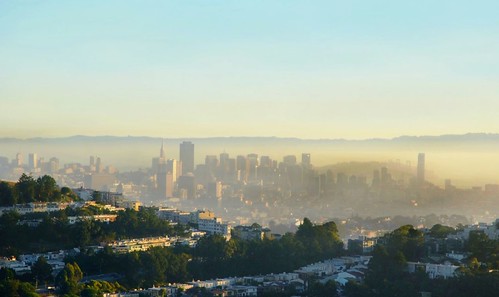
San Francisco stretches in a curve under a sky the color of salmon: the bright western dawn that Caspar David Freidrich so loved. The sky interpolates a you: you had to be here to see it, writes Joseph Koerner. On a heroic January morning, it’s hard to look out over that pink, clear sky and not inhale with a whiff of emotions rising.

Some of that information is mine alone. I’m staying in a friend’s apartment, partaking of a view of the Mission District Grid from the south, a thousand three-story workers’ apartments reflecting white roofs. This is the view I used to jog every morning in grad school. I used to jog past the houses of small-time rock stars and local documentarians, past the overgrown garden where old hippies gave away avocados, past the friary where Franciscans fed soup to the homeless, the bar where I’d fallen asleep with the arm of a novelist around me, the alleyway where my best friend had read my tarot cards. The city was a map of emotions; walking it from the level of a sidewalk, I could run into the ghost of a painful argument at any time. But above, with the dog-park and the other joggers, I’d feel those labyrinths of experience falling away into another view. I’d look out at a city of people I’d argued with, fought against, cried with, feeling it all slip below me, a system distinct from me, separable, whose many stories remained accessible but also distant.

That hill is my spiritual cleansing. This bright January morning, it still has the power to put me back from immediacy, and fear trickles down away from me to the valley below. Any hilltop view in San Francisco gives me this feeling of levity, freedom, and abstraction. Some of that cleansing power of the city is mine, the after effect of a ritual I practiced every day for years, now ingrained in memory. The map of encounters and romances, of personal narratives woven into particular alleyways are mine; the view, the attitude, the adjustment, are each a creation of personal experience are also. Both are rituals of a personal narrative, both relics of the way I lived when I lived in this city. Standing on the hilltop, I might even mistake what I see in the city for my own experience, but in truth, most of it is not.

The rose-colored sky is itself inherited; we borrowed it from the nineteenth-century golden dawn painters who saw sunrises over Swiss forests. I see the city through the eyes of nineteenth-century investors and artists, I see Jack London’s Oakland, I see the broad-shouldered laborers depicted in WPA murals from the 1930s. Struck by the whiff of freedom beneath the California stars last night, I cough language borrowed by Woody Guthrie from the throat of Muir, who parsed Thoreau and Rousseau into American dialect.

The grid that stretches before us is administered by a dozen different invisible agencies which enforce the socio-economic pattern of the rich on the hillsides and the poor in the valley. That grid was the product of mapping by state and capital: by investors, affiliated with the railroads, who laid down the shape of a city to be; three different grids, torqued at different angles, by three different companies who began to plan from the east and west and south of the pinensula at different times. The maps were adopted by state authorities, who used them to see where to send trolley-car lines and water pipes, and by banks, who used them to guess where whites lived (and where to make loans) and where lived others (where to deny them).

The horizon is mountains dotted with houses, then sky: the border where this landscape ends. I’ve just come, this time, from the other side of those hills, and I’m aware in every conversation I have in San Francisco about the limits of the world view here. If Midwestern chemtarails are real, and the people of San Francisco where the activists are don’t know about it, they’ll never write about it to change it. Katrina struck the rest of the country more deeply. Gaza rings more loud. There are privileges associated with that world-view: every conversation I have here will flow easily into recycling, spirituality, and altnerative healing, where I’d have to scrimmage to claw at such ideas or people in the Midwest. The anti-Israel protest swings by, two hundred men and women of all ages and ethnicities, some with banners from the Episcopalian church and some of them Jews against Zionism, and one feels an uplift of possibility, of small social movements forming, demanding peace, wondrous to be in San Francisco now, ground zero for social utopianism. But there are limits. That parade, like the anti-war rallies against Bush in the 2000s, will never be covered outside of local news. Almost all the social movements launched here die before they cross those hills. Like the land of Oz, we’re surrounded by an impassable waste on every side, crossed only by natural disaster and magic slippers.

Landscape is the single most important tool mankind has for keeping information away. The developer who practices unwise investment strategies to the risk of investors has only to hide those properties over the horizon. Diamond miners with unscrupulous attitudes towards unions had only to practice their trade in Africa. Conducted in plain sight, within the sphere of everyday interactions, conspiracy and murder would never pass; there in another world, they become everyday affairs. Landscape, a system of boundaries and limits to vision, conspires with corruption.

This world is greater than me, my personal world being shaped by the map of a city created by distant administrators a century ago; even my sense of light, my preference for a certain kind of café with its French tables ranging the sidewalk and doors the length of the bar thrown open, the reflection of other cafes, cultivated by French bohemians now dead, documented, popularized, digested, recreated, so that I and other would-be artists could congregate there. I live in a city where three-fourths what I see is a relic of someone else’s glasses, someone else’s blueprints, someone else’s election.

To decode this world, I need not only politics but also aesthetics and philosophy; it is not merely the laws that govern loans and taxes that shape this world, but also preferences for beauty, imitated and disseminated. By landscape I mean that system of boundaries, conjoined, overlapping, self-perpetuating, invisible, and unavoidable, which subsist in space and structure my experience. The boundaries interpolate and imbricate each other; they’re mistaken for each other, like when I think that I have personally struggled to become more free because I live in San Francisco where the natives chant the history of civil rights all the time. The boundaries are some very old and political, like the angled route of Mission Street, once the Camino Royale, which runs past the site of the old mission of Saint Francisco di Asis all the way south to Mexico City; and some of them are as recent as the fluctuating line of gang warfare on 22nd street, or the invisible boundary around Chaim’s house, which makes me think in lines from Bob Dylan and Rimbaud whenever I cross 14th towards Natoma. Landscape is all the boundaries, personal and political, inscribed on the horizontal world by the accretion of time.

Labels: , , , , , ,

Thursday, April 19, 2007

Jo's Favorite Books on Esoteric Landscape

In this post, we go down the rabbit hole to investigate the landscapes people see in out-of-body meditations, the landscapes of the paranoid and schizophrenic, and the landscapes of other times and places.

Landscape scholars (like me) spend most of our time writing about (literally) concrete subjects -- like the rise of eminent domain, how railroads connected the nation, or how project housing demoralizes communities.

But somewhere at the bottom of this concern is the fact that landscape is a common structure of consciousness. Everybody sees the common landscape. Right?

Here, in random meditative order, are the most important books that helped me think about what we see when we look at the landscape -- and what we don't see.

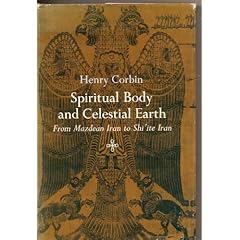
#1 -- Henry Corbin, Spiritual Body and Celestial Earth: From Mazdean Iran to Shi'ite Iran (French title, Terre céleste et corps de résurrection: de l'Iran mazdéen a l'Iran shî'ite, 1960, English version, 1977).

Corbin investigates the imaginary geographies of Ancient Persia, where Zoroastrian and Shiite scholars regularly described out-of-body flights through concretely-imagined landscapes. Numerous sheiks describe the same cities and rivers on the other side of death. They agree that this “esoteric” landscape is the concretization of Persian values, imagined as a real space. Acknowledging the concreteness of their perceptions, however, leads them to question whether any part of common experience is not structured by the perception of value.

They speculate about the necessary concreteness, authenticity, and predominance of this world – indeed, that the centers, borders, and sites of importance that we collectively perceive in this world are also another collective dream, a map of our values.

The capital cities and mountains of the real Persia, they suggest, are no less an externalization of Persian values than the map of the Persian afterlife. They agree, then, that this earth is an angel – a collective dream, whose contours we agree on only in the same way that we agree on the contours of imaginary geographies.

Five stars.


What you see, where you go, what places you know to exist, where the borders of the known world lie – all of this is a product of collective dreaming; everything is in the realm of perception, according to the Zoroastrians.

Persian mystics raise heckles among readers who see them as the dreamy commentary of the contemplative soul. This isn't easy going for your standard college graduate. The mystics are so interesting, however, because their out-of-body flights tell them (and us) a great deal about the role of landscape in organizing knowledge.

As Corbin explains, mystic experience depended upon a shared concept of values mapped out in space -- a map of an imaginary world so real that one sheik after another could, it seemed, visit it. Persian mystics claimed to share common visual experiences of their flights through the ether, consistently visiting the same imaginary world in their hallucinations, over hundreds of years. The mystic map of the universe is resilient, Corbin suggests, because place organizes our imagination on an extremely basic level.

This insight about a shared map of value, how it structures what we perceive and what we don't perceived, has been at the root of some of the twentieth century's deepest questions about how consciousness works. Artists, geographers, philosophers, and psychologists have codified the value-laden connotations associated with various places. A continuous trend of collective emotions, values, and ideas associated with place is quite clear. What are these common perceptions of geography, and how are they structured?

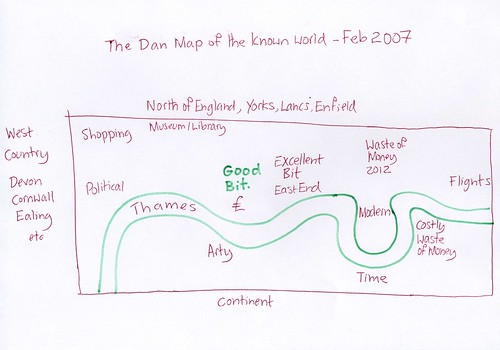
In the “Maps from Memory” group on Flickr, artists share their own maps from childhood or from travels in the past.


In addition to those maps of our own heads are maps of collective experience and reckoning. Artists share their diagrams of the known world, and their diagrams of mythic places that never were. What’s so striking about these images is their resonance with a common experience. The “simplified map of London,” for example, deals better with London’s history than many long treatises I know.


So if there are common emotional maps of today’s places, surely there were similar value-geographies of places in the past. And surely the story of how a certain place became important, and what it meant to people, and what they did there, is a subject of immense importance to the cultural historian.

We can name the stories of certain places in history that rose to great importance. The medieval cult of saints and holy wells, for instance, or the pilgrimage to Santiago. Bunyan’s Pilgrim’s Progress and the eighteenth-century road network gave us idea of a path whose destination one shares with strangers. The nation-state as a natural and eternal shape upon the earth is a nineteenth-century landscape. Agorophobia and claustrophobia are constructs of the late nineteenth century. If the map in your mind and the paths your feet work are both the products of collective dreaming, that dreaming still takes place in history.

THE VALUE-LANDSCAPE OF THE ANCIENT WORLD
M. Detienne, The Gardens of Adonis: Spices in Greek Culture -- the entire plant world of Ancient Greece was mapped according to the values and alchemical properties each was said to possess. An immense body of Greek myth refers to designating the position of each plant and each God within this hierarchy of value, from the wet to the dry, the bland to the spicy.
Vidal-Naquet, Pierre. The Black Hunter : Forms of Thought and Forms of Society in the Greek World. Baltimore: Johns Hopkins University Press, 1986. – includes a synoptic map of the Greek city, from the sacred interior to the outside world of barbarians, in between which is the liminal space of the forest, of wild animals, where young boys in puberty are sent to come of age, protecting themselves against beasts, without weapons, before they are allowed to ascend to the places of power in Greek politics.
Tilley, Christopher Y. A Phenomenology of Landscape: Places, Paths, and Monuments, Explorations in Anthropology. Oxford, UK; Providence, R.I.: Berg, 1994. – on monoliths, processional rocks, and observation ledges by the sea in Ancient Britain
Yates, Frances Amelia. The Art of Memory. Chicago,: University of Chicago Press, 1966. – on the memory palaces and memory maps used to organize knowledge of the entire world

VALUE-LANDSCAPES OF THE MODERN WEST
Gaston Bachelard, The Poetics of Space -- Bachelard reviews all of Western literature from the high to the low and excavates the psychological trace of a collectively imagined landscape, where hidden secrets and tunnels are in the basements of all the houses in the world, and ancestors in its attics.
Michael Bakhtin, The Chronotope – Nineteenth- and twentieth-century novels dwell excessively on the landscapes of the gothic (remote castles and houses in ruins where individuals are inextricably connected to the remote past)
Henry Glassie, Passing the Time at Ballymenone – In modern Ireland, the real houses, streets, urban centers, and hills are each intricately connected to an imaginary map of witchcraft, safety, and community.
Paul Carter, Repressed Spaces – Agorophobia was only invented after 1890 when individuals associated with psychology


THE GEOGRAPHICAL THEORY OF VALUE
Quite solid, continuous, and static maps of value exist in the modern world. When people draw a map of a place they used to know, they draw the particular locations that are associated with their own memories. Even modern societies have monuments where the venerate collective memory, central cities where industry is concentrated, and social spaces where they play. A shared social map of the world exists, and divides all the world into political centers, social borderlands, and sites of memory.

Yi-Fu Tuan, Topophilia
Michel de Certeau, The Practice of Everyday Life

THE PSYCHOLOGICAL THEORY OF PLACE
Jung and Reich wonder, what are the archetypal kinds of place and boundary that structure our experience? What primal places characterize the collective imaginary map of the West? Eliade points to the axis mundi, which characterizes every map in the West from the ancient world to the present. There is, they insist, a collective imagination of the geographical world. Reich notices that psychological disorders cause people to hold their bodies differently. Paranoia, for instance, causes the subject to stop perceiving the outside world. What range of ways do we understand our bodies? If there is such a thing as a collective map, there is also a range of individual attitudes towards that map. These collective and individual attitudes structure how we hold our bodies, what we perceive of physical reality, and what we build in the physical environment.

Carl Jung, Aion
Wilhelm Reich, Character Analysis and Orgonomy.
Mircea Eliade, Sacred and Profane

Labels: , , , , , , , , , , ,