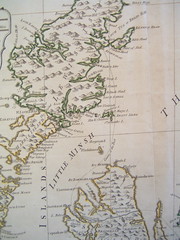
Landscape organizes everything within sight.

Monday, March 29, 2010

The Invisible Frontier: Thrivability Essay, 2010

(the following essay was my contribution to Jean Russell's digital pamphlet, Thrivability, which outlines the pathways to a new economy built upon respect for humans, the value economy, and the environment. Read more about Jean's vision at her blog, Thrivable)

The invisible frontier is the location of the zones where modernity has failed to make good on its promises: famines, wars, corrupt bureaucracies; ghettos without exits. For those who rest content in the faith that capital heals everything, the invisible frontier remains invisible. When confronted with rumors of people on the other side, they characterize those people as monsters : the great unwashed, living in a devil’s playground of arson and gang wars.

The old-fashioned capitalists are wrong about what things look like across the invisible frontier. That way lies information, precious information. The information tells us about modernity’s failures, about government abuses and neglect, about disintegrating markets. A drive through the wrong side of town shows the grocery stores that are closing their doors, the encampments of homeless, the empty factories.
A drive through the Rust Belt shows quick the devastation hidden from coastal enclaves: entire neighborhoods, demolished. Standing skyscrapers, vacant. New empty lots, cleared by arson. Closing schools. Closing hospitals. Abandoned old folks’ homes. No one can afford them. This information is frequently of a kind useful to those who care about the future: it shows how bad the economy is and how much worse it could get. The invisible frontiers show what happens in the breakdown of capitalism and government: they show the societies of hobos, the existence of spontaneous guilds in trailer parks, child-care co-ops, community gardens, and utopian storefronts. The
invisible frontier is the location of experiments that rival capitalism.

In general, invisibility happens because of lack of access to capital, social or otherwise. The son-of-a-preacher public health expert hasn’t walked the back roads of Liverpool and has preconceptions about what the inhabitants need: they need morality before they need running water. The son-of-a-preacher knows who to talk to in parliament; the Liverpudlians do not. Another example: the health-insurance lobbyist
can buy access to the Senator; devoted student activists cannot. People on the other side of the digital divide -- the 12% whom the Pew tells us have not even a dial-up connection -- cannot tell Silicon-Valley engineers to design community-participation software that runs off of cell phones.

Insidiously, however, the invisibility of people is usually mutual. Even if you volunteered to design infrastructure tailored to the people on the other side of the digital divide, they might have a hard time answering the question. The uses of infrastructure are new to a people who lost their houses to highways. Poor factory-workers in nineteenth-century Liverpool choked when they went to Parliament.
They didn’t know which functionary they would speak to, or which language with which they would interact if they found him. A whole host of functionaries have arisen since 1870 with the attention of bridging these gaps: public schools, social workers, outreach centers, organizers, and activists. All of our modern institutions produce a
surfeit of paper. The institutions of freedom -- from Parliament and Congress to the school board to the IRS and the design of the internet -- are shrouded in paper, their inner workings invisible to the people who would benefit the most therefrom.

Landscape invisibility compounds class invisibility. Stockton, a foreclosure capital, is home to Hispanic truck-drivers and factory-workers who have lost their houses in great numbers. They are no different than other, better-known working-class immigrants in San Diego, Chicago, and New York. However, Stockton is off the map. First, the poor lose their landscape; next, they become invisible. Whatever capital has forgotten about dissolves like the soft paper of midcentury paperbacks, crumbling in the hand. On the digital landscape, the overworked and harried rarely contribute to community web2.0 bike-maps. They too become invisible. We keep planning, however, as if there were no frontier, and nothing invisible beyond it.

The truly sustainable, the thrivable designer, reaches hands across the invisible frontier. It reaches across the digital divide, and puts technology for rethinking government, energy, and food directly in the hands of those communities who live in food ghettos (where there are no grocery stores) and dial-up deserts (where one pays
upwards of $40/mo for a slow connection on a pc shared by 5). Thrivable design listens patiently, it enters dialogue with potential users who find the new terms difficult, whose interests and resources and foreign to those who come from a state of capital.

Thrivability recasts the designer's place: no more in the halls of power, hanging out in shiny buildings in well-kept cafes with others of money; now instead, the designer belongs in the city, on public transit, exploring the suburban ghetto. Thrivable design on the invisible frontier pays attention to all those details of life hidden in the landscape -- the public places where strangers meet, the memory of people who have migrated a long way together, the corridors people travel who don't have access to funds.

The thrivable designer sees life -- people trying to make a living, communities that need tools -- where old-fashioned capitalists see only failure. Thrivability recasts the designer's role: no more the paid lieutenant of corporation and state; now, instead, the wanderer around invisible peripheries, the witness and facilitator of emergent states.

Reblog this post [with Zemanta]

Labels: , , , , , , , ,

Monday, October 12, 2009

The Future of Social Science in the Era of the Internet

Social science today has an opportunity to create an online infrastructure for social valuation that becomes participatory to a degree far exceeding the contemporary rule. While nineteenth-century social scientists worked for government elites, an online infrastructure designed to illuminate world view would place the tools of cultural observation within reach of many minds. Opening up representation of landscape has the opportunity to directly channel participation into urban planning, tax policy, housing policy, social services, and other aspects of the representation and administration of the physical landscape. It is hoped that application, articles, and videos will pioneer a new role for social science in the era of social networking technology, and foreground the cause of democratizing social science’s power.

So long as government interests dominated the social sciences, the work of the social scientist aimed at influencing the work of the national government. Historian, sociologist and geographer worked to describe cases of state success and failure, expectant that the state would build according to their plans. The end of that political relationship opens up a radical opportunity. Social scientists in the age of the internet have the opportunity to work directly on behalf of communities without the interface of government.

In the age of the internet, radical participatory information exchanges, market and political exchanges replace much of the work of the state. In such a setting, many of the social science’s traditional roles become irrelevant. Social scientists no longer advise a state in charge of designing public spaces where members of identity groups can safely meet. Informal, market-driven social servers such as LinkedIn.com, Facebook.com, and Myspace.com become significant forums for social exchange. Social scientists such as danah boyd have documented the divides of race and class in these sites. But who do they advise? There are no urban planners overseeing Facebook.

Few social scientists have explored the radical opportunities available at the level of design. Launched from independent geeks, corporate start-ups, and computer science departments, new applications spring up constantly, tweaking the infrastructure of social exchange. One application allows Flickr.com photos to appear on Facebook’s wall. Another shows the user a rotating cloud of all the pictures semantically related to a given search term. Fundamentally, these applications are about making connections; their success actually depends upon broadening the internet’s infrastructure to become as participatory as possible.

One of the greatest challenges to participatory exchange on the internet is the limit of transcultural boundaries. Users’ gender, class, race, and identity are obscured online, surfacing as an invisible law of self-association. Reduplicating the isolation of society at large, affluent whites on the internet share information with affluent whites, while the children of immigrants or immigrants themselves populate.

Here the history of the academic disciplines provides insight. Social scientists employed by the state once combated ethnic segregation in the city by prescribing programs such as public housing designed to enhance identity assimilation. Their work tended to generalize racial differences into differences of violence, gender organization, and attitudes towards work.

Armed with new forms social expertise – planners, architects, and geographers – charged with managing the boundaries between cultural worlds, based upon the assumption that the only way world views could be reconciled at large was through the management of the state. Nowhere was this trend clearer than among the experts who embarked upon a discipline new to the twentieth century, the study of cities. Urban scholarship flourished around what was becoming known as the “urban crisis,” the post-civil-rights-era phenomenon of black inner-cities ringed by ethnically divided white suburbs. Intellects as diverse as economist Edward Glaeser, geographer David Harvey and historian Arthur Schlesinger Jr. examined the historical health of urban administration with an eye to the future of racial integration in America. Geographers asked whether overcrowding in public housing contributed to interracial violence. Child psychologists asked whether access to green spaces influenced the development of creative powers. Social scientists intended to describe the ideal city, and they expected the state to build it.

Their efforts, frequently belittling or primitivizing minority ethnicities, urged their students to concentrate upon designing a single, ideal, national landscape: a design for cities, frequently modernist, that would help immigrants of many backgrounds to assimilate to the same culture. By ignoring difference, they hoped to efface it. Their trajectory was marked by failure, and by the year 2000, Chicago and St. Louis were tearing down the housing projects erected under that regime.

Faith in expert management of cultural infrastructure by sociologists and psychologists gave rise to an unprecedented level of authority being given modern urban planning. The public housing projects erected under their charge took American and British neighborhoods out of the hands of the local ethnic minorities who had built them. Far from the master travelers envisioned by early students of world view, twentieth-century planning aimed to assimilate ethnic minorities by effacing cultural difference.

By contrast, in advising and enabling the oversight of design for online infrastructure, academics in the social sciences can facilitate collaborative knowledge making by communities about themselves.

Labels: , , , , , , , , , , ,

Thursday, October 08, 2009

Social Engineering, Race, and Geography in the 1970s

When the geographer Peter Gould sat down to write his autobiography in 1990, he looked over a career of mapping the perceptual spaces of Swedes, Tanzanians and college students. Over that life, he had repeatedly claimed that his major contribution to knowledge had been primarily in the service of the state. Gould was the man who figured out how to draw a picture of the version of the nation in a given individual’s head: ask the person to name all the cities they can in the United States; map those.

The results remind us that human beings live in worlds of constructed of personal experience, not in atlases. New Yorkers can name all the boroughs and a smattering of places on the East Coast; Chicagoans can name factories in the Midwest with no resonance at all in San Francisco. The studies he produced were magically suggestive of the distance between worlds: children of fishermen can name and draw every cove round an island; not so those who live on the mainland. Even the citizens of relatively homogenous civilizations, he suggested, could be separated by experience into separate universes of perception, interest, and prejudice.

For most of his career, Gould, like the geographers of his generation, claimed that these findings should interest state bureaucrats. Writing about his first “mental maps” in 1968, he claimed that his audience was bureaucrats “in government service” concerned with “income differentials” and the potential for relocating “migratory movements” in line with industry. Brian Berry of the University of Chicago was even more explicit, announcing to the Annual Conference of the Institute of British Geographers in 1970 that in the new world of “meritocratic élites,” geographers found themselves servants to the “needs of public policy.” He imagined a world where geographers would project the cities of the future that were “most likely to emerge in the future with and without public intervention” and so help functionaries decide and find the tools to shape the most preferable community possible.

This was hardcore social engineering: the idea was that geographers, like psychologists and other social scientists, would aid the twentieth-century state in helping poor people and people of minority races to assimilate, or failing that, in Berry’s words, to “monitor” contemporary developments and so apprise authorities of outbreaks of danger before they happened. Geographers varied in which elites they thought they were advising. David Harvey’s early work specifically targeted the reform of federal mortgage administration. Yi-Fu Tuan emphasized not policy but rather urban planning, and hoped that his literary analyses of landscape would help designers to achieve “a habitat in concert with the full potential of our being.”

Geographers varied as to which areas they thought most merited intervention. Gould claimed that his personal contribution was establishing that isolated islanders had trouble learning about jobs on the mainland; Ley and Cybriwsky used graffiti to discern the most troubled areas of black-Puerto Rican conflict in Philadelphia. Harold Rose defined the city center from St. Louis to Atlanta as a “high risk homicide environment.” Brian Barry was most worried about the poor blacks and white elderly isolated in the impoverished hinterland. Geography was to be the psychological surveillance arm of the state, tracing the zones of isolation and despair emerging around America, in order to more intelligently apply some combination of architecture, welfare, and policing.

A significant group of geographers directed their findings towards the state's management of race. The Chicago School of sociology had mapped racial segregation of Chicago’s neighborhoods since the 1930s, but by blending of psychology and their mapping skills, a new generation of geographers began to rival them. Edward T. Hall’s study of public and private space, The Hidden Dimension (1966), blended studies of rats and slums to argue that overcrowded cities produced escalating acts of violence and decreasing fertility among females.

The studies exploded in the 1960s, offering explanations to confused white Democrats who demanded to know why the passage of the 1965 Equal Rights Act had only resulted in further riots in Watts and Detroit. Applying terms like “overcrowding,” “territoriality,” and “isolation,” geographers charged into the causes and consequences of racial segregation in cities.

The geographers located answers in American zones of isolation and hopelessness. Bill Bunge organized his fellow professors into the Detroit Geographical Expedition, leading frequent trips to document the slums of Detroit and later Toronto. Their findings were equally provocative. In 1968, the Society published a map entitled “Where Commuters Run Over Black Children on the Pointes-Downtown Track.” Life and death, they argued, were not merely the commodities available to any hard-working American, but hung upon the thread of a special kind of privilege, the privilege of safe territory.

That privilege became all the more identifiable in the wake of a series of geographical investigations of racial covenants, which forbid people of color from owning property, and redlining, the practice setting racial qualifications for home loans within certain neighborhoods. Geographers documented the problem in 1960 and 1972, and in David Harvey explained that the high price of mortgages for blacks in Baltimore justified all Marx had said about the direct relationship between high rents and social exclusion.

Describing the deep structuration of the urban crisis became the geographer’s favorite tool. Addressing the Association of American Geographers in 1978, its president, Harold Rose, coined the term “geography of despair” to interpret rising figures for homicide in black neighborhoods. Geographical investigation and race questions and climaxed in Zev Chafet‘s much-acclaimed Devil’s Night (1990), a book that defined the recent spate of black-on-black arson as reaction to white flight in a scene of hopelessness. Black hopelessness, among the social geographers, as the greatest social crisis of the moment, justified their concern. With so much evidence, it was all the more easy for implacable black hopelessness to become a convention of American belief.

The surveying of racial crisis began with advising the state necessarily distanced the geographer from the place he described. Whatever the revolutions within geographers’ hearts, most of them reported, like Gould, to the state, more frequently advising urban planners, architects, and task forces than grassroots networks. They wrote about sexuality and violence in the slum.

Rather than creating sympathy with the victims of race and class, their reports read like porn to the white audiences who consumed them. In The Hidden Dimension, Edward Hall drew parallels between overcrowded rats and contemporary black neighborhoods, indicting both as “behavioral sinks.” Documenting the spread of graffiti from ghetto backstreets to public highways in 1972, David Ley and Roman Cybriwsky explained a “behavioral primitive” akin to animals marking out territory.

Even when taking a conciliatory attitude, privileged observers defined their subjects as the passive victims of environmental forces. Rose wrote of his study of homicide, “Youth who find difficulty establishing themselves in American society are less prone to abide by the norms of the larger society,” the direct result of which was untamed aggression among black and hispanic males, lashing out against strangers. Friedmann and Miller concluded, with equal finality, that the poor whites in deindustrialized rustbelt towns were “short both on civic leadership and hope. They can neither grasp the scope of the events that have overtaken them nor are they capable of responding creatively to the new situations.” Racialized or not, the environmental forces described in the reports were both final and damning.

By 1990, however, Peter Gould had glimpsed another use for his mental maps. He had been watching over thirty years how his classes of eighty to a hundred people responded to seeing him explain the vast differences of experience between growing up in a black ghetto and a white suburb. They stopped in their tracks, he wrote, to realize that “their location in geographic space seemed to determine to a high degree the information they had.” As the undergraduates learned to understand their aesthetic tastes and political attitudes as a reflection of where they grew up, he wrote, they began to ask where they were located “in ‘ethnic space,’ ‘religious space,’ and ‘gender space.’”

The question, at base, as he formulated it, was actually a question most provocative when aimed at his privileged, white undergraduates: “How free really were they when they were trapped by their locations in these other spaces?”

Labels: , , , , , , , , , , ,

Tuesday, August 04, 2009

In praise of surre(gion)alism

Max Cafard's Surre(gion)alist Manifest first appeared in Exquisite Corpse in 1990 and was afterwards republished with a preface by New Orleans poet Andrei Codrescu. Arguing for the eminence of the local as a point of view, the manifesto urged readers to consider their own perspective, political and culture, as the outcome of their existence at a certain place and time. It argued that only in radical utopian moments such as May 1968 do individuals become able to envision life beyond the bounds of their own history.

I had the great joy of getting to meet Max and hang out back in May while passing through New Orleans. We met for coffee in the afternoon and talked about landscapes till late at night. He told me about his ancestors, how they'd come to New Orleans trying to save the family farm back in France. I got to hear about Max's travels through anarchist experiments around Europe in the 60s. I got to hear about New Orleans' travelers who tack between racial neighborhoods, till the invisible boundaries break down and new worlds become visible. I got to hear about living in New Orleans in the breakdown around Katrina, when Max's son, intimate with the ghettos and slums of many races, ended up naked in prison for days, then housed in solitary for months, unbeknownst to his relatives.

Max's major opus, the Surre(gion)alist Manifesto, excavates radical European and Chinese philosophy for a new political philosophy appropriate to twenty-first century America. It looks back to the radical individual Taoism of Lao Tse, the utopian experiments of nineteenth-century Europe, the anarchist/individualist critique of Dada, and the radical Situationist Internationale of 1960s Paris, searching for a utopian logic that respects the radical difference of place and individual will. The intellectual roots here are serious: the analysis of psychogeography pioneered by Bachelard, Dubord, and De Certeau, combined with the Henri Lefebvre's critique of capitalism. Cafard reduces, engineering a new dialectic of liberation, a landscapey recipe, the navigation between the "utopian nowhere of meaning and the topian density of earth."

In the Manifesto, attention to local landscape offers a movement towards political and economic liberation. Cafard urges, Strive to reject the people who would manage you from another place far away, whether they are capitalists or teachers. Try not to be like them: try to live instead in the landscape of your journey, taking lessons from the cities and seasons where you find yourself.

This injunction to inhabit the local first, as a beginning of a radical politics, is explained more fully in another fine essay, "Deep Play in the City." Here Cafard applies radical psychogeography as an instruction set for looking at urban landscapes. Landscapeyness becomes the beginning of radical political freedom.

Back over on Landsploitation, the experimental film channel for all things landscapey, Max has let me put up the video version of the Manifesto, presented by Cafard's student Andrew Goodrich. If you'd prefer the text version, you can find it here.

I'd like to take this opportunity to remind readers that I curate two videocasts about everyday landscape. Landsploitation presents experimental videos and sound. Dilettantes and film geeks both welcome. The Landscape Studies Podcast presents work by my colleagues, typically papers that have been read already at conferences, excerpts of talks, or summaries of scholarly articles. Itunes listeners, subscribe to Landsploitation and Landscape Studies. Both are accepting submissions.

Labels: , , , , , , , ,

Thursday, April 19, 2007

Jo's Favorite Books on Esoteric Landscape

In this post, we go down the rabbit hole to investigate the landscapes people see in out-of-body meditations, the landscapes of the paranoid and schizophrenic, and the landscapes of other times and places.

Landscape scholars (like me) spend most of our time writing about (literally) concrete subjects -- like the rise of eminent domain, how railroads connected the nation, or how project housing demoralizes communities.

But somewhere at the bottom of this concern is the fact that landscape is a common structure of consciousness. Everybody sees the common landscape. Right?

Here, in random meditative order, are the most important books that helped me think about what we see when we look at the landscape -- and what we don't see.

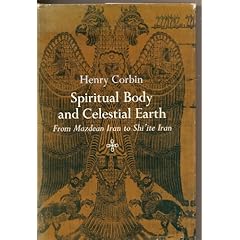
#1 -- Henry Corbin, Spiritual Body and Celestial Earth: From Mazdean Iran to Shi'ite Iran (French title, Terre céleste et corps de résurrection: de l'Iran mazdéen a l'Iran shî'ite, 1960, English version, 1977).

Corbin investigates the imaginary geographies of Ancient Persia, where Zoroastrian and Shiite scholars regularly described out-of-body flights through concretely-imagined landscapes. Numerous sheiks describe the same cities and rivers on the other side of death. They agree that this “esoteric” landscape is the concretization of Persian values, imagined as a real space. Acknowledging the concreteness of their perceptions, however, leads them to question whether any part of common experience is not structured by the perception of value.

They speculate about the necessary concreteness, authenticity, and predominance of this world – indeed, that the centers, borders, and sites of importance that we collectively perceive in this world are also another collective dream, a map of our values.

The capital cities and mountains of the real Persia, they suggest, are no less an externalization of Persian values than the map of the Persian afterlife. They agree, then, that this earth is an angel – a collective dream, whose contours we agree on only in the same way that we agree on the contours of imaginary geographies.

Five stars.


What you see, where you go, what places you know to exist, where the borders of the known world lie – all of this is a product of collective dreaming; everything is in the realm of perception, according to the Zoroastrians.

Persian mystics raise heckles among readers who see them as the dreamy commentary of the contemplative soul. This isn't easy going for your standard college graduate. The mystics are so interesting, however, because their out-of-body flights tell them (and us) a great deal about the role of landscape in organizing knowledge.

As Corbin explains, mystic experience depended upon a shared concept of values mapped out in space -- a map of an imaginary world so real that one sheik after another could, it seemed, visit it. Persian mystics claimed to share common visual experiences of their flights through the ether, consistently visiting the same imaginary world in their hallucinations, over hundreds of years. The mystic map of the universe is resilient, Corbin suggests, because place organizes our imagination on an extremely basic level.

This insight about a shared map of value, how it structures what we perceive and what we don't perceived, has been at the root of some of the twentieth century's deepest questions about how consciousness works. Artists, geographers, philosophers, and psychologists have codified the value-laden connotations associated with various places. A continuous trend of collective emotions, values, and ideas associated with place is quite clear. What are these common perceptions of geography, and how are they structured?

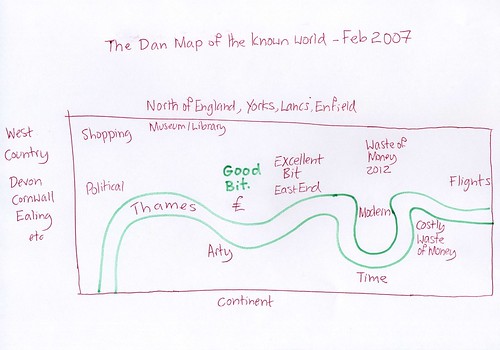
In the “Maps from Memory” group on Flickr, artists share their own maps from childhood or from travels in the past.


In addition to those maps of our own heads are maps of collective experience and reckoning. Artists share their diagrams of the known world, and their diagrams of mythic places that never were. What’s so striking about these images is their resonance with a common experience. The “simplified map of London,” for example, deals better with London’s history than many long treatises I know.


So if there are common emotional maps of today’s places, surely there were similar value-geographies of places in the past. And surely the story of how a certain place became important, and what it meant to people, and what they did there, is a subject of immense importance to the cultural historian.

We can name the stories of certain places in history that rose to great importance. The medieval cult of saints and holy wells, for instance, or the pilgrimage to Santiago. Bunyan’s Pilgrim’s Progress and the eighteenth-century road network gave us idea of a path whose destination one shares with strangers. The nation-state as a natural and eternal shape upon the earth is a nineteenth-century landscape. Agorophobia and claustrophobia are constructs of the late nineteenth century. If the map in your mind and the paths your feet work are both the products of collective dreaming, that dreaming still takes place in history.

THE VALUE-LANDSCAPE OF THE ANCIENT WORLD
M. Detienne, The Gardens of Adonis: Spices in Greek Culture -- the entire plant world of Ancient Greece was mapped according to the values and alchemical properties each was said to possess. An immense body of Greek myth refers to designating the position of each plant and each God within this hierarchy of value, from the wet to the dry, the bland to the spicy.
Vidal-Naquet, Pierre. The Black Hunter : Forms of Thought and Forms of Society in the Greek World. Baltimore: Johns Hopkins University Press, 1986. – includes a synoptic map of the Greek city, from the sacred interior to the outside world of barbarians, in between which is the liminal space of the forest, of wild animals, where young boys in puberty are sent to come of age, protecting themselves against beasts, without weapons, before they are allowed to ascend to the places of power in Greek politics.
Tilley, Christopher Y. A Phenomenology of Landscape: Places, Paths, and Monuments, Explorations in Anthropology. Oxford, UK; Providence, R.I.: Berg, 1994. – on monoliths, processional rocks, and observation ledges by the sea in Ancient Britain
Yates, Frances Amelia. The Art of Memory. Chicago,: University of Chicago Press, 1966. – on the memory palaces and memory maps used to organize knowledge of the entire world

VALUE-LANDSCAPES OF THE MODERN WEST
Gaston Bachelard, The Poetics of Space -- Bachelard reviews all of Western literature from the high to the low and excavates the psychological trace of a collectively imagined landscape, where hidden secrets and tunnels are in the basements of all the houses in the world, and ancestors in its attics.
Michael Bakhtin, The Chronotope – Nineteenth- and twentieth-century novels dwell excessively on the landscapes of the gothic (remote castles and houses in ruins where individuals are inextricably connected to the remote past)
Henry Glassie, Passing the Time at Ballymenone – In modern Ireland, the real houses, streets, urban centers, and hills are each intricately connected to an imaginary map of witchcraft, safety, and community.
Paul Carter, Repressed Spaces – Agorophobia was only invented after 1890 when individuals associated with psychology


THE GEOGRAPHICAL THEORY OF VALUE
Quite solid, continuous, and static maps of value exist in the modern world. When people draw a map of a place they used to know, they draw the particular locations that are associated with their own memories. Even modern societies have monuments where the venerate collective memory, central cities where industry is concentrated, and social spaces where they play. A shared social map of the world exists, and divides all the world into political centers, social borderlands, and sites of memory.

Yi-Fu Tuan, Topophilia
Michel de Certeau, The Practice of Everyday Life

THE PSYCHOLOGICAL THEORY OF PLACE
Jung and Reich wonder, what are the archetypal kinds of place and boundary that structure our experience? What primal places characterize the collective imaginary map of the West? Eliade points to the axis mundi, which characterizes every map in the West from the ancient world to the present. There is, they insist, a collective imagination of the geographical world. Reich notices that psychological disorders cause people to hold their bodies differently. Paranoia, for instance, causes the subject to stop perceiving the outside world. What range of ways do we understand our bodies? If there is such a thing as a collective map, there is also a range of individual attitudes towards that map. These collective and individual attitudes structure how we hold our bodies, what we perceive of physical reality, and what we build in the physical environment.

Carl Jung, Aion
Wilhelm Reich, Character Analysis and Orgonomy.
Mircea Eliade, Sacred and Profane

Labels: , , , , , , , , , , ,