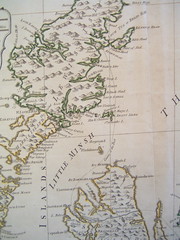
Landscape organizes everything within sight.

Tuesday, August 04, 2009

In praise of surre(gion)alism

Max Cafard's Surre(gion)alist Manifest first appeared in Exquisite Corpse in 1990 and was afterwards republished with a preface by New Orleans poet Andrei Codrescu. Arguing for the eminence of the local as a point of view, the manifesto urged readers to consider their own perspective, political and culture, as the outcome of their existence at a certain place and time. It argued that only in radical utopian moments such as May 1968 do individuals become able to envision life beyond the bounds of their own history.

I had the great joy of getting to meet Max and hang out back in May while passing through New Orleans. We met for coffee in the afternoon and talked about landscapes till late at night. He told me about his ancestors, how they'd come to New Orleans trying to save the family farm back in France. I got to hear about Max's travels through anarchist experiments around Europe in the 60s. I got to hear about New Orleans' travelers who tack between racial neighborhoods, till the invisible boundaries break down and new worlds become visible. I got to hear about living in New Orleans in the breakdown around Katrina, when Max's son, intimate with the ghettos and slums of many races, ended up naked in prison for days, then housed in solitary for months, unbeknownst to his relatives.

Max's major opus, the Surre(gion)alist Manifesto, excavates radical European and Chinese philosophy for a new political philosophy appropriate to twenty-first century America. It looks back to the radical individual Taoism of Lao Tse, the utopian experiments of nineteenth-century Europe, the anarchist/individualist critique of Dada, and the radical Situationist Internationale of 1960s Paris, searching for a utopian logic that respects the radical difference of place and individual will. The intellectual roots here are serious: the analysis of psychogeography pioneered by Bachelard, Dubord, and De Certeau, combined with the Henri Lefebvre's critique of capitalism. Cafard reduces, engineering a new dialectic of liberation, a landscapey recipe, the navigation between the "utopian nowhere of meaning and the topian density of earth."

In the Manifesto, attention to local landscape offers a movement towards political and economic liberation. Cafard urges, Strive to reject the people who would manage you from another place far away, whether they are capitalists or teachers. Try not to be like them: try to live instead in the landscape of your journey, taking lessons from the cities and seasons where you find yourself.

This injunction to inhabit the local first, as a beginning of a radical politics, is explained more fully in another fine essay, "Deep Play in the City." Here Cafard applies radical psychogeography as an instruction set for looking at urban landscapes. Landscapeyness becomes the beginning of radical political freedom.

Back over on Landsploitation, the experimental film channel for all things landscapey, Max has let me put up the video version of the Manifesto, presented by Cafard's student Andrew Goodrich. If you'd prefer the text version, you can find it here.

I'd like to take this opportunity to remind readers that I curate two videocasts about everyday landscape. Landsploitation presents experimental videos and sound. Dilettantes and film geeks both welcome. The Landscape Studies Podcast presents work by my colleagues, typically papers that have been read already at conferences, excerpts of talks, or summaries of scholarly articles. Itunes listeners, subscribe to Landsploitation and Landscape Studies. Both are accepting submissions.

Labels: , , , , , , , ,

Thursday, March 22, 2007

How Delicious is Changing Academic Research

As of a recent post on Google Books and the research of History, our quiet little blog here on academic history, activism, and spirituality has suddenly gotten more notoriety than it's accustomed to. Hi world! Thanks for stopping by. To carry on with the thread of how information travels for academics, and what the 'net is doing, let's talk about another of my favorite sites for research, del.icio.us.

Delicious is the Rome, Jerusalem, and Paris of my existence as an academic these days. It's where I make my friends, how I get the news, and where I go to trade. All this from a little server that does nothing but share bookmarks in public.

Why? Two reasons it's cool. 1) It sorts things. 2) it makes them public.

1) it sorts things.

For two years I've been using Delicious as an information organizer. It's produced an impressive encyclopedia of the most interesting information, images, articles, citations, books, and subjects on the internet to which I might want to refer. Consider my dissertation tag, under which are a wide variety of online images and google books that I'll be using for my research. Not only can I come back to them, but I can also find related subjects -- dissertation material related to walking -- navigating seamlessly from one to another. As an improvement on the index card system, or on my own terrifying piles of articles (even now ornamenting my bookshelf), or even on the folders within folders within folders of word documents, this represents a definite improvement.

I've been building a taxonomy -- the way some people use wikis, the way my boyfriend uses that utterly cool personal software, "the brain;" the way my father uses his vertical file, the way my DC friends use their rolodexes -- so I sort out all the information I take in, annexing technology to memory, sorting factoids and spare threads and notable evidence in neat, interlocking piles where I can find information again, draw connections, and create new connections.

The result is a navigable taxonomy of my thoughts. If I want to find my stuff on the history of "walking," the taxonomy already knows that my material on walking is associated with other categories of knowledge which I've tagged nearby.

After a year of using delicious for my own bookmarks, helping other people find things becomes remarkably easy. Many of the link lists below are simply cut and paste over from delicious. Lists of citations for colleagues are cut and paste from delicious into email. The forty American history students I teach are instructed to go to my delicious page for writing help, research help, maps, and images relating to the class.


Second reason delicious is cool:

2) it makes things public.

Not only can you look at your own bookmarks, but you can also look at others'. When you find something noted to be queer and interesting, you can find out what other topics that same person thinks to be queer and interesting.

What's rapidly happening with these shared tags is academics finding each other in rapid numbers. I have some twenty people in my network, at least half of whom I've never met in real life. They include:

* Javier Arbona, a graduate student in Geography who's also at the University of California, Berkeley
* Travis Brown, a graduate student in literature
* LeahB, an editor at Cabinet Magazine, my favorite periodical
* bibliparis4, a librarian at one of the public universities in Paris

Each of these is another intellectual putting together rarified connections about strange pieces of thought somehow related to my world.

I found them because they were, like me, publicly tagging with some arcane tag that I also use. c19 -- the nineteenth century tag. vernacular -- a tag used by other people who work with ephemera.

Every morning, I log into my delicious network and read the links that my small army of admired, clever, canny, eccentric brains has put together for me.

What's more, I'm developing what I'd consider an actual working relationship with these other scholars. A few of them have added me to their own networks. Day to day, I watch their reactions to Bush, I get a sense of where their research is going, and they get a sense of mine. It's low-level, low-commitment hanging out with high levels of information exchange.

And this is something different than the social activity I know anywhere else on the internet.

Normally, if you want to meet people on the internet, the connections are typically time-limited and action-specific. You want a date, you want sex, you need a friend of a friend for networking in Argentina. You meet up online and then you meet in real life. Or you meet online at Myspace and then, unless you have a crush on the person, forget to ever go back again. But my scholars are folks I'm seeing on a regular basis in the course of my regular research. This is the nearest thing to running into someone else at the card catalog yet.

I don't check in with them. I don't have, nor do I really need, the capacity to send email to them. Some of them I may actually encounter at academic conferences later, and we'll share more of a bond, through our years of doing collaborative research, than many scholars who have labored through the years in adjoining offices.

As Hannah Arendt understood, the modern democratic state happened when people in public spaces began interacting, and thus began taking action together. For this reason, she identified the medival carnivals and fair days of Europe as the seat of literature, culture, debate, and politics. The rule goes like this: make a public, get action. Today, Delicious does for the internet what open-air markets did for medieval society. Low key, high-information, continuous-formation community building.

All hail the bookmark market.

Labels: , , , , , , , ,

Tuesday, March 20, 2007

Journalism's Greatest Hope

7:40 PM
j guldi: WOW
7:45 PM
Chloe Cockburn: hullo
j guldi: wow, this is like the best journalism in our lifetime...
j guldi: an actual intelligent use of history...
j guldi: what planet have i been on? i've never heard of this guy?
Chloe Cockburn: yes i think it's quite elegant
Chloe Cockburn: i hear him mentioned now and then but i didn't realize he was this good
Chloe Cockburn: i've heard this argument before of course but he says it very well
j guldi: beautifully
j guldi: mentions debs but doesn't distract by going into socialism, communism...
j guldi: a coherent narrative drawing americanism into one coherent idea, against which he polarizes bush
j guldi: liberals usually get wishy-washy in outrage without feeling able to identify with a public
Chloe Cockburn: indeed
j guldi: so there's no reason for a public to listen to them
j guldi: can we get more people like this?
7:50 PM
Chloe Cockburn: clone him!
j guldi: yay!

Labels: , , , , , , , , , , , ,

Saturday, March 17, 2007

Falwell's Ghost, in California


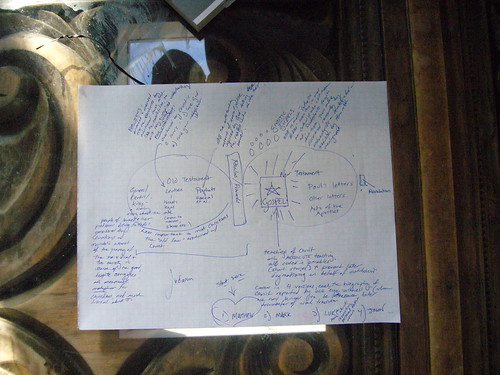
I was explaining the Bible to jerry. That's his coffee table.

Jerry: "so is this the part where it says, I am your angry task-master, you must obey me and kill other people?"

Jo: (goes silent)

No.

(pause)

It says, I am the way, the truth, and the light. It's a mystical statement. It's practically exactly the way the Tao de Ching begins, the Road you can name is not the real road; the name you can say is not the real name. It's mysticism. Where are you getting this stuff, anyway?

----


Seriously, you do-gooder Christians with big well organized churches have a lot of basic disinformation evangelism to do. Jerry's smart, in touch, and we've been having this conversation for six months. He's pretty exemplary of at least 50% of the well educated and liberal out here. I get to have a similar conversation in San Francisco every time I meet a stranger who discovers that I go to church : how could I believe that crap? hasn't anyone told me yet that it's patriarchal and power-hungry? Don't I know that it's all about killing and hating? Decades of exposure to Falwell (the only Christian voice to penetrate to the unconverted) have done a lot of damage.

Hearing the wrong Christians interviewed on Fox News and chatted about in the New York Times means a version of Christianity twisted beyond recognition. The New Testament, in the churches of the South and Midwest, has relatively little to do with hating or excluding. Instead, it focusses on the main substance of the Christian scripture, becoming a good listener and expressing loving speech through a connection with a force of love bigger and grander than that expressed by any given particular human over the course of his life. I realized something strange in the midst of this conversation with Jerry. I've spent most of the last ten years learning how to talk about the Christian Right and Christian Left, to draw political lines about who's right and who's wrong. But I wasn't cultivating my speech about love, or honing my testament to the deep, spiritual, inward experiences I've had.

I'm shocked when other people don't understand think Christianity is an institution whose prime purpose is the cultivation of those experiences in a supportive community. But I myself am part of the problem. I'm used to drawing lines in the sand between those Christians there with their hate-preaching, and our Christians over here. I'm great at describing when, how, and why those divisions arose. But on a regular basis I'm not part of the tide of those actually sharing, or enthusiastically advocating, the kind of ecstatic experiences I regularly experience in my readings of the Sermon on the Mount, the psalms, the Sufi scriptures, and the Tao. Evangelism is supposed to be about the healing of broken souls, the outreach to people with a certain hollowness in their lives.

Religion is not just about politics, that much seems obvious. The political aspect is important and dear to those of us trying to distance ourselves from the angry harmful nonsense of Falwell. Activists tend to be warriors and statesmen in this game, drawing lines and collecting help. They (we) tend to blame the media, exhort pastors to preach on political topics, and encourage a healthy, political body in the church, engaging the progressive world view. They tend to leave the preaching, meditation, witness, exultation, sharing of experiences, deep listening, and descriptions of love to priests and preachers.

Maybe too much. Maybe Falwell has won because too many Christians on both sides, right and left, engage the politics without the love.

Labels: , , , , , , , , , ,