Landscape organizes everything within sight.

Wednesday, October 14, 2009

The Awakening of Psychogeography: Child Psychology, 1923-1977, and the perception of landscape

From 1923, when Melanie Klein published her psychological studies of children playing in sandboxes, to 1977, when the first studies of place cells were published, the primary field of new research in the mental processing of the landscape was child psychology. Piaget and Donald Winnicott claimed claimed to study the “infant’s point of view.” Piaget observed children drawing objects and discerned the lack of a sense of a Cartesian grid in their mental worlds; things that were emotionally near were reached for as if physically near. The psychoanalyst Edith Cobb, embarking on a long-term study of childhood experience, identified a formative period between five and twelve, when most of a child’s energy was directed not towards parents or friendships but rather towards place. At this age, she wrote, “the natural world is experienced in some highly evocative way, producing in the child a sense of some profound continuity with natural processes and presenting overt evidence of a biological basis of intuition.”

Play for the infant, Winnicott argued, happened in a space with neither “inner psychic reality” nor “external reality.” He describes a dialectic between merging with mother and separation that is reduplicated with every nonliving object around the child, in particular blankets, teddy-bears, or other cherished objects that the child can alternately caress and attack, treating one moment as the human extension of her own body and the next as an insensate object, its button eyes to be torn out. The sense of self and otherness is therefore gradually formed in the “potential space between the individual and the environment.” The environment becomes thus infested with creative play that invests all objects in the immediate landscape with valuation, extrapolation, and association.

Cobb showed children Rorschach tests and watched them play in sand boxes. She observed with fascination how the children seemed to express emotional attachment in play with objects more vividly than with people or animals.

“I became acutely aware that what a child wanted to do most of all,” she wrote, “was to make a world in which to find a place to discover a self.”

Winnicott defined two different kinds of childhood learning about the environment: the first, “favourable” outcome happens an abundance of individual symbols and fascinations projected onto the environment: “the potential space becomes filled with the products of the baby's own creative imagination.” The landscape where childhood play is allowed becomes “sacred to the individual” as the place where she “experiences creative living.” This is the world of play, characterized by a sense of wonder, free enjoyment, and easy association that Winnicott lauds as giving children a sense of the fullness of their own potential and the many riches of experience. It takes the form of turning any landscape into a magical wonderland, invested with the potential of encountering fairies or taking adventure.

The second outcome, Winnicott argued, would happen in cases of “failure of environmental reliability,” when a baby absorbs adults’ perspectives on the environment. This form of learning teaches the child about zones of danger and safety, but discourages play, and so, Winnicott concludes, is less consistent with the individual development of an internal life, of the ability to critique authority, or of risk-taking behavior outside. Individual imagination in safe childhood exploration of landscape was thus set up against collective order of the environment and the manufacture of a disciplined, uncritical subject.

Most adults, Winnicott argues, have experience of both playspace and discipline. Mature adults can return to access their mental worlds of play, the space of “unintegration,” which he defines as a “day-dream-like” state where fantasy, dream, and real world meet, inner projections applied and then separated from real-world objects, the limits of self and other readjusted. Only by relating to the landscape, he thought, did children have the opportunity of distinguishing themselves as independent entities, of parsing “the nature and interrelationship of inner and outer objects and worlds.”

(Photo thanks: cc 2006 Ian)

Labels: , , , , , ,

Tuesday, August 04, 2009

In praise of surre(gion)alism

Max Cafard's Surre(gion)alist Manifest first appeared in Exquisite Corpse in 1990 and was afterwards republished with a preface by New Orleans poet Andrei Codrescu. Arguing for the eminence of the local as a point of view, the manifesto urged readers to consider their own perspective, political and culture, as the outcome of their existence at a certain place and time. It argued that only in radical utopian moments such as May 1968 do individuals become able to envision life beyond the bounds of their own history.

I had the great joy of getting to meet Max and hang out back in May while passing through New Orleans. We met for coffee in the afternoon and talked about landscapes till late at night. He told me about his ancestors, how they'd come to New Orleans trying to save the family farm back in France. I got to hear about Max's travels through anarchist experiments around Europe in the 60s. I got to hear about New Orleans' travelers who tack between racial neighborhoods, till the invisible boundaries break down and new worlds become visible. I got to hear about living in New Orleans in the breakdown around Katrina, when Max's son, intimate with the ghettos and slums of many races, ended up naked in prison for days, then housed in solitary for months, unbeknownst to his relatives.

Max's major opus, the Surre(gion)alist Manifesto, excavates radical European and Chinese philosophy for a new political philosophy appropriate to twenty-first century America. It looks back to the radical individual Taoism of Lao Tse, the utopian experiments of nineteenth-century Europe, the anarchist/individualist critique of Dada, and the radical Situationist Internationale of 1960s Paris, searching for a utopian logic that respects the radical difference of place and individual will. The intellectual roots here are serious: the analysis of psychogeography pioneered by Bachelard, Dubord, and De Certeau, combined with the Henri Lefebvre's critique of capitalism. Cafard reduces, engineering a new dialectic of liberation, a landscapey recipe, the navigation between the "utopian nowhere of meaning and the topian density of earth."

In the Manifesto, attention to local landscape offers a movement towards political and economic liberation. Cafard urges, Strive to reject the people who would manage you from another place far away, whether they are capitalists or teachers. Try not to be like them: try to live instead in the landscape of your journey, taking lessons from the cities and seasons where you find yourself.

This injunction to inhabit the local first, as a beginning of a radical politics, is explained more fully in another fine essay, "Deep Play in the City." Here Cafard applies radical psychogeography as an instruction set for looking at urban landscapes. Landscapeyness becomes the beginning of radical political freedom.

Back over on Landsploitation, the experimental film channel for all things landscapey, Max has let me put up the video version of the Manifesto, presented by Cafard's student Andrew Goodrich. If you'd prefer the text version, you can find it here.

I'd like to take this opportunity to remind readers that I curate two videocasts about everyday landscape. Landsploitation presents experimental videos and sound. Dilettantes and film geeks both welcome. The Landscape Studies Podcast presents work by my colleagues, typically papers that have been read already at conferences, excerpts of talks, or summaries of scholarly articles. Itunes listeners, subscribe to Landsploitation and Landscape Studies. Both are accepting submissions.

Labels: , , , , , , , ,

Tuesday, February 10, 2009

A Psychogeography of San Francisco


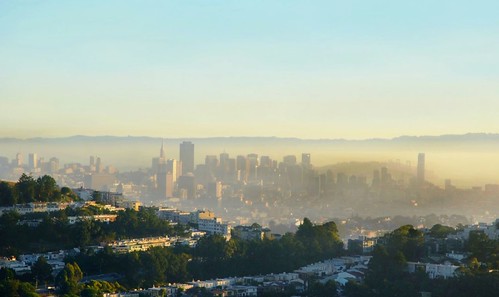
San Francisco stretches in a curve under a sky the color of salmon: the bright western dawn that Caspar David Freidrich so loved. The sky interpolates a you: you had to be here to see it, writes Joseph Koerner. On a heroic January morning, it’s hard to look out over that pink, clear sky and not inhale with a whiff of emotions rising.

Some of that information is mine alone. I’m staying in a friend’s apartment, partaking of a view of the Mission District Grid from the south, a thousand three-story workers’ apartments reflecting white roofs. This is the view I used to jog every morning in grad school. I used to jog past the houses of small-time rock stars and local documentarians, past the overgrown garden where old hippies gave away avocados, past the friary where Franciscans fed soup to the homeless, the bar where I’d fallen asleep with the arm of a novelist around me, the alleyway where my best friend had read my tarot cards. The city was a map of emotions; walking it from the level of a sidewalk, I could run into the ghost of a painful argument at any time. But above, with the dog-park and the other joggers, I’d feel those labyrinths of experience falling away into another view. I’d look out at a city of people I’d argued with, fought against, cried with, feeling it all slip below me, a system distinct from me, separable, whose many stories remained accessible but also distant.

That hill is my spiritual cleansing. This bright January morning, it still has the power to put me back from immediacy, and fear trickles down away from me to the valley below. Any hilltop view in San Francisco gives me this feeling of levity, freedom, and abstraction. Some of that cleansing power of the city is mine, the after effect of a ritual I practiced every day for years, now ingrained in memory. The map of encounters and romances, of personal narratives woven into particular alleyways are mine; the view, the attitude, the adjustment, are each a creation of personal experience are also. Both are rituals of a personal narrative, both relics of the way I lived when I lived in this city. Standing on the hilltop, I might even mistake what I see in the city for my own experience, but in truth, most of it is not.

The rose-colored sky is itself inherited; we borrowed it from the nineteenth-century golden dawn painters who saw sunrises over Swiss forests. I see the city through the eyes of nineteenth-century investors and artists, I see Jack London’s Oakland, I see the broad-shouldered laborers depicted in WPA murals from the 1930s. Struck by the whiff of freedom beneath the California stars last night, I cough language borrowed by Woody Guthrie from the throat of Muir, who parsed Thoreau and Rousseau into American dialect.

The grid that stretches before us is administered by a dozen different invisible agencies which enforce the socio-economic pattern of the rich on the hillsides and the poor in the valley. That grid was the product of mapping by state and capital: by investors, affiliated with the railroads, who laid down the shape of a city to be; three different grids, torqued at different angles, by three different companies who began to plan from the east and west and south of the pinensula at different times. The maps were adopted by state authorities, who used them to see where to send trolley-car lines and water pipes, and by banks, who used them to guess where whites lived (and where to make loans) and where lived others (where to deny them).

The horizon is mountains dotted with houses, then sky: the border where this landscape ends. I’ve just come, this time, from the other side of those hills, and I’m aware in every conversation I have in San Francisco about the limits of the world view here. If Midwestern chemtarails are real, and the people of San Francisco where the activists are don’t know about it, they’ll never write about it to change it. Katrina struck the rest of the country more deeply. Gaza rings more loud. There are privileges associated with that world-view: every conversation I have here will flow easily into recycling, spirituality, and altnerative healing, where I’d have to scrimmage to claw at such ideas or people in the Midwest. The anti-Israel protest swings by, two hundred men and women of all ages and ethnicities, some with banners from the Episcopalian church and some of them Jews against Zionism, and one feels an uplift of possibility, of small social movements forming, demanding peace, wondrous to be in San Francisco now, ground zero for social utopianism. But there are limits. That parade, like the anti-war rallies against Bush in the 2000s, will never be covered outside of local news. Almost all the social movements launched here die before they cross those hills. Like the land of Oz, we’re surrounded by an impassable waste on every side, crossed only by natural disaster and magic slippers.

Landscape is the single most important tool mankind has for keeping information away. The developer who practices unwise investment strategies to the risk of investors has only to hide those properties over the horizon. Diamond miners with unscrupulous attitudes towards unions had only to practice their trade in Africa. Conducted in plain sight, within the sphere of everyday interactions, conspiracy and murder would never pass; there in another world, they become everyday affairs. Landscape, a system of boundaries and limits to vision, conspires with corruption.

This world is greater than me, my personal world being shaped by the map of a city created by distant administrators a century ago; even my sense of light, my preference for a certain kind of café with its French tables ranging the sidewalk and doors the length of the bar thrown open, the reflection of other cafes, cultivated by French bohemians now dead, documented, popularized, digested, recreated, so that I and other would-be artists could congregate there. I live in a city where three-fourths what I see is a relic of someone else’s glasses, someone else’s blueprints, someone else’s election.

To decode this world, I need not only politics but also aesthetics and philosophy; it is not merely the laws that govern loans and taxes that shape this world, but also preferences for beauty, imitated and disseminated. By landscape I mean that system of boundaries, conjoined, overlapping, self-perpetuating, invisible, and unavoidable, which subsist in space and structure my experience. The boundaries interpolate and imbricate each other; they’re mistaken for each other, like when I think that I have personally struggled to become more free because I live in San Francisco where the natives chant the history of civil rights all the time. The boundaries are some very old and political, like the angled route of Mission Street, once the Camino Royale, which runs past the site of the old mission of Saint Francisco di Asis all the way south to Mexico City; and some of them are as recent as the fluctuating line of gang warfare on 22nd street, or the invisible boundary around Chaim’s house, which makes me think in lines from Bob Dylan and Rimbaud whenever I cross 14th towards Natoma. Landscape is all the boundaries, personal and political, inscribed on the horizontal world by the accretion of time.

Labels: , , , , , ,